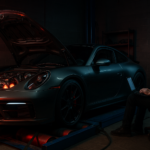
McLaren dyno tuning near Dallas requires a very specific skill set. The twin turbocharged engines found in the 570S, 720S, 765LT, and GT demand calibration tools and expertise that most shops simply do not have. At Motek EuroWerkz, located in Plano, Texas just north of Dallas, our team performs full load dyno sessions purpose built for McLarens and other exotic vehicles. We map AFR curves, dial in knock thresholds, and calibrate boost pressure with the precision these cars deserve.
If you own a McLaren in the DFW area and want real, measurable power gains without gambling your engine, this guide explains exactly how we do it and why the process matters.
Why McLarens Demand Specialist Dyno Calibration
McLaren builds its engines with extremely tight tolerances. The M838T, M840T, and M840TE families are high compression, twin scroll turbocharged units that respond sharply to fuel and ignition timing changes. A generic tune written on a dynamometer not calibrated for McLarens can push AFR ratios into dangerous territory at peak load. Detonation can destroy a piston crown in seconds.
Our performance dyno tuning program at Motek is designed around the unique demands of exotic cars, and McLarens sit at the center of that focus. We use a Dynapack hub mounted dyno that eliminates tire slip variables and delivers load bearing accuracy that a roller dyno cannot match. Every pull is repeatable, and every data log is reviewed before we write a single parameter change.
Reading the AFR Curve: The Foundation of Safe McLaren Power
Air fuel ratio is the single most important variable in any turbocharged engine calibration. For a McLaren running on 93 octane pump fuel, a wide open throttle AFR target typically sits in the 11.5 to 12.0 range. That window provides enough fuel charge cooling to protect the combustion chamber while still releasing the energy needed for strong torque output.
Where things get dangerous is in the transition zones. Mid throttle transients from 30 percent to 70 percent load are where lean spikes often hide. A factory ECU map is calibrated conservatively to account for global fuel quality variation. When we remap a McLaren on our Plano dyno, we log every throttle position across the full RPM sweep, identify lean pockets, and enrich those cells with precision. The result is a smoother, more linear power delivery that feels more responsive in daily driving, not just at the strip.
We also run a dedicated lambda trace on every dyno pull, cross referencing broadband wideband readings against the target map in real time. If a cell drifts more than 0.3 lambda from target, we stop, investigate, and correct before continuing. This is not optional. It is how professional exotic car tuning is done.
Knock Detection: Protecting Your McLaren at Full Load
Knock, also called detonation, is the enemy of any high compression turbocharged engine. When the air fuel mixture self ignites before the spark event, the resulting pressure wave is violent enough to crack ring lands, destroy piston tops, and damage bearing surfaces. In a McLaren, where engine rebuilds start around $30,000, knock protection is not a feature. It is a necessity.
Our calibration process uses external knock monitoring hardware alongside the factory knock sensors. McLaren’s OEM knock management system is competent, but it is calibrated to pull timing aggressively at the first sign of instability. That protects the engine during a factory tune but can mask tuning decisions that need to be corrected at the root rather than papered over with timing retard.
During every dyno session, we monitor individual cylinder knock events at a resolution the stock ECU log cannot show. If we detect persistent knock on a single cylinder, we investigate fuel injector flow, compression ratio deviation, or intercooler efficiency before advancing timing further. A tune built on top of a mechanical issue is not a tune. It is a liability.
Boost Calibration: How We Set Safe Limits Without Leaving Power on the Table
The twin turbos on a McLaren 720S are capable of producing significantly more boost pressure than the factory map requests. Stock target boost on the 720S M840T is approximately 22 psi at peak load. Aftermarket calibrations targeting 26 to 28 psi are common and achievable on a well maintained stock engine with upgraded intercoolers.
The challenge is in the ramp rate. A boost map that spikes too quickly at low RPM can overwhelm the intercooler charge temperature capacity and create heat soak that compounds on consecutive pulls. Our approach is to build the boost curve progressively, hold the calibration for two pulls, then log charge air temperature at the manifold before committing to a higher target. We never chase peak boost numbers without confirming that the thermal management system is keeping pace.
We also pay close attention to wastegate duty cycle maps. On some McLarens, particularly higher mileage examples with minor turbo wear, the boost control response becomes inconsistent. We catch that during dyno loading, and we address it before the final map is locked.
The Motek McLaren Dyno Tuning Process, Step by Step
When a McLaren owner brings their car to our Plano facility, here is what the process looks like from intake to delivery.
- Pre tune inspection. We put the car on our lift and inspect spark plugs, fuel injectors, intercooler condition, and turbo compressor wheel health. A tuning session on a compromised engine produces a compromised result.
- Baseline dyno pull. We establish a stock or initial power baseline on the hub dyno, logging AFR, boost, timing advance, and charge air temperature across the full RPM range.
- ECU data extraction. Using McLaren compatible tooling, we extract the live calibration file and open it in our mapping environment.
- Iterative calibration pulls. We write targeted changes to fuel, ignition, and boost maps, make a pull, review logs, and repeat. No live street tuning. Every change is made in a controlled environment.
- Safety hold. After every significant boost increase, the car sits for 15 minutes to normalize coolant and charge temps before the next pull.
- Final verification pull. We lock the map, perform a final full load pull from 2,000 RPM to redline, and confirm AFR, timing, and boost targets are all within spec.
- Delivery debrief. You receive a printed dyno sheet and a data log summary. We walk through what changed, why, and what to watch for in the first 500 miles.
If the car requires additional mechanical work before the calibration is safe, we handle that in house through our full McLaren service program. Tuning and mechanical work under one roof means no gaps in accountability.
Serving McLaren Owners Across Dallas, Plano, Frisco, and DFW
Motek EuroWerkz is based in Plano, Texas, minutes from the Dallas North Tollway. That puts us in a convenient position for McLaren owners across the DFW metro, including clients who drive in from Frisco, Allen, McKinney, Southlake, and central Dallas.
Our clients are typically people who already know what proper exotic car tuning looks like. They have done the research. They know the difference between a shop that loads a generic map file and one that builds a calibration from scratch on a hub mounted dyno with real data behind every cell. That is the standard we hold ourselves to, and it is why McLaren owners from across DFW choose to make the drive to Plano.
Our dyno tuning services cover a range of exotic platforms beyond McLaren, but our depth of McLaren specific experience is what sets Motek apart in this market. We understand the architecture. We have the tooling. And we are close enough to serve the entire DFW corridor without asking you to make a long haul.
Frequently Asked Questions
How much power can a McLaren 720S gain from a dyno tune?
On a stock 720S with no hardware modifications, a professional dyno calibration typically yields 30 to 50 horsepower and 40 to 60 foot pounds of torque at the wheels. Results vary based on ambient conditions, fuel quality, and the specific build of the individual engine. Adding upgraded intercoolers or a high flow air intake can push those gains higher, but baseline calibration on OEM hardware is still meaningful.
Will a dyno tune void my McLaren warranty?
In the United States, the Magnuson Moss Warranty Act limits a manufacturer’s ability to void a warranty simply because aftermarket tuning was performed. However, if a mechanical failure is directly caused by a calibration change, the manufacturer can decline coverage for that specific failure. We document every calibration session thoroughly so there is a clear record of what was changed and why. We recommend discussing your specific warranty situation with your McLaren dealer before proceeding with any ECU modifications.
Do I need to bring my own fuel for a dyno session?
For most pump fuel calibrations, 93 octane is standard and we verify the tank is full before starting. If we are calibrating for E30 or E85 blends, we ask that you bring the car already fueled with the intended blend, or we can coordinate that logistics for you in advance. Do not mix fuel grades before a dyno session without telling us. It changes the calibration baseline and can compromise the results.
How long does a McLaren dyno tune take at your Plano shop?
A full McLaren dyno calibration session typically takes four to six hours, including the pre tune inspection, baseline pulls, iterative calibration, and final verification. We block the full day for exotic dyno sessions and do not rush the process. If we discover a mechanical issue during the pre tune inspection, we will pause the session, give you a clear explanation, and discuss options before continuing.
Ready to Unlock Your McLaren’s Real Power?
If you own a McLaren in the Dallas or Frisco area and want a dyno calibration done right, Motek EuroWerkz is your facility. We are located in Plano, TX, just north of Dallas, with the equipment, data, and track record to back up every session. Visit our McLaren service page to learn more about our full range of McLaren capabilities, or head to our performance dyno tuning page to see the full scope of what we offer. When you are ready to schedule, use our contact form and let us know your platform, current mileage, and any modifications already on the car. We will put together a session plan before you ever drop off the keys.