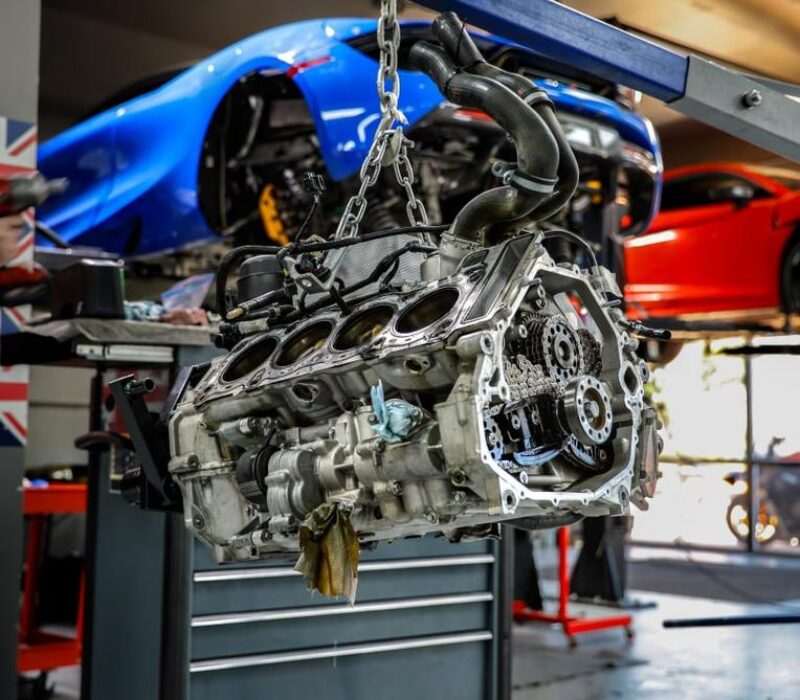

When a McLaren owner in Dallas brings their car in for what they think is a simple oil leak or a misfire, what gets uncovered during a proper diagnostic often tells a different story. A real McLaren engine rebuild in Dallas is not a parts swap. It is a structured teardown, a methodical inspection, and a rebuild sequence that follows engineering tolerances down to fractions of a millimeter. At Motek EuroWerkz, we have completed full M838T and M840T engine builds, and the gap between a proper rebuild and a surface repair job becomes obvious fast. This is what that gap actually looks like.
The Three Failure Modes That Bring a McLaren Engine to the Build Bench
Most McLaren engine problems fall into one of three categories, and each one requires a different level of intervention. Understanding which failure mode you are dealing with determines everything about how the engine gets handled next.
Cylinder Bore Coating Wear
McLaren uses a Nikasil-style cylinder bore coating on both the M838T and M840T platforms. This coating is harder than cast iron sleeves and reduces friction at operating temperature, but it is not indestructible. High-mileage engines, engines run consistently hard without proper warm-up, and engines that saw extended periods of oil degradation all show coating wear on inspection.
The problem with bore coating wear is that it rarely triggers a fault code. By the time it shows up as a performance issue, ring seal has already been compromised. The only reliable way to confirm bore condition is through a bore scope inspection and cylinder leakdown test. A shop that skips this step during a rebuild and assumes the bores are fine is setting up the owner for a repeat visit within 18 to 24 months.
IPAS Bearing Failure
The IPAS (Integrated Pre-Assembled System) main bearing is one of the most discussed failure points in McLaren’s twin-turbocharged engines. It is not a flaw in the platform design so much as a sensitivity that demands strict maintenance habits and correct oil specification throughout the engine’s life.
IPAS bearing failure happens in stages. In the early phase, oil film degradation begins at the bearing surface. In the middle phase, metal-to-metal contact starts transferring material onto the crankshaft journal. By the time the engine throws a rod bearing noise, journal surface damage has already occurred. A shop that replaces the bearings without measuring and potentially regrinding the crankshaft journals is not completing the repair. It is delaying the next one.
At Motek, every M838T and M840T rebuild includes crankshaft journal measurement against OEM spec tolerances. We document the readings and make the journal regrind decision based on actual data, not on visual inspection alone. You can learn more about how we approach these platforms on our McLaren service page.
Hot-Side Turbo Housing Fatigue
The McLaren twin-turbo setup runs the hot-side housing under sustained thermal stress that most street cars never experience. Track use, repeated wide-open-throttle runs, and extended periods of high-load highway driving all accelerate hot-side fatigue. The cast iron housings develop micro-cracks over time, and those cracks do not always present as visible exhaust leaks. They present as inconsistent boost, reduced spool response at lower RPM, and in some cases, a faint exhaust odor under boost that owners often attribute to something else entirely.
A proper McLaren turbo inspection includes pressure testing the housings, checking wastegate actuator response, and measuring turbine shaft play against the specification range. A shop that visually inspects the turbo and calls it serviceable has not done the work.
Factory-Spec Teardown Protocol on the M838T and M840T
McLaren publishes technical reference documentation through their TechInfo portal that outlines the correct disassembly and measurement sequence for both the M838T (used in the 570S, 600LT, and 720S) and the M840T (used in the 765LT). Both platforms share a similar twin-turbo architecture but have different displacement, bore spacing, and piston specifications that require platform-specific procedures at every stage.
A proper teardown follows torque sequence documentation during disassembly to prevent warping head surfaces and bearing cap bores. Plastigauge verification is used on every rod and main bearing cap to confirm clearances against spec before any decision is made about whether a bearing can be reused or must be replaced. MDS-platform dimensional measurements cover the crankshaft, camshaft journals, and cylinder bores using calibrated tooling, with every reading logged against the factory allowable range.
This is not optional procedure on a rebuild of this cost and complexity. It is the difference between knowing what the engine actually measured at teardown and guessing at it. Build sheets document every measurement taken and every part decision made, and that documentation travels with the car when it leaves the shop.
Where Shops Cut Corners on McLaren Engine Builds
The most common shortcut is the parts swap without full disassembly. A shop pulls the heads, replaces the visible problem component, and reassembles. This approach ignores bore condition, bearing clearances, and crankshaft surface integrity entirely. The engine goes back together and it runs, until it does not, typically at the worst possible moment.
The second shortcut is skipping MDS measurements and relying on visual inspection. Experienced technicians can spot obvious damage visually, but clearance measurements require calibrated tooling and documented readings. Visual inspection does not catch a crankshaft journal that is 0.003 inches undersize or a cylinder bore that is out of round by two-thousandths. Both of those conditions will cause premature bearing failure in a rebuilt engine.
The third shortcut is sourcing non-OEM or unverified aftermarket bearings for a platform engineered with specific oil clearances. Bearing clearance on the M838T crankshaft runs within a tight tolerance window. A bearing that is slightly undersized will run tight and accelerate wear under heat. One that is slightly oversized will allow too much journal movement and reduce oil film stability at high load. Neither failure is dramatic at first, and both are invisible until a deeper problem surfaces.
None of these shortcuts show up on the invoice. None of them are visible to the owner until the car is back in the shop. By then, the cost of a proper repair has increased, not decreased.
Motek’s Documented Build Process for M838T and M840T Engines
Every McLaren engine rebuild at Motek EuroWerkz starts with a documented inspection phase before any parts are ordered. We complete a full teardown and measure everything that matters. The owner receives a written summary of findings with actual measured values and a parts list that reflects what the engine needs based on those findings, not a generic rebuild package applied without context.
From there, the rebuild follows factory torque sequences with documentation at each stage. We use OEM-spec bearings as the baseline and upgrade only when a client has a documented power target that requires deviation from stock specification. Cylinder bore work, when needed, goes to a machine shop we have a working relationship with, and those measurements are verified on return before reassembly begins.
Hot-side turbo housings are pressure-tested on every engine that comes through for a full rebuild. If a housing fails the test, it gets replaced before the engine goes back together. We do not install a rebuilt engine into a car with a turbo housing that has not been pressure-verified. That is a standard we hold on every build regardless of the client’s timeline pressure.
The final step before delivery is a datalog review under load. For performance-oriented builds, a dedicated dyno session provides the baseline pull and confirms the engine is producing power within the expected range for the specification. This validation step is part of our custom performance build process at Motek and applies to every build where power output is a documented deliverable.
McLaren’s technical reference documentation, available through the McLaren TechInfo portal, outlines the factory measurement and assembly standards that govern this work. We treat those specifications as the baseline for every build and document every engineered departure when a client’s performance target calls for it.
What This Means for McLaren Owners in Dallas
A surface job on a McLaren engine is not a money-saving decision. It is a delayed expense with added labor cost when the overlooked problems surface a year or two later. The M838T and M840T are precision platforms, and they respond to precision work. They also respond to the absence of it, and the feedback is expensive.
If you are evaluating a McLaren engine rebuild in Dallas, a few questions will tell you everything you need to know. Does the shop document measurements at teardown? Do they follow platform-specific torque sequences? Do they pressure-test the turbo housings? Do you receive a build sheet with your car? At Motek EuroWerkz, the answer to all of those is yes.
Our team works on exotic platforms as the core of our business, and McLaren engine builds are a significant part of what we do. If your car is showing symptoms or you have an upcoming service interval where these systems need assessment, contact us through our McLaren service page, review our custom performance build process, or explore our full range of exotic auto repair services to understand the full scope of what Motek delivers in Dallas.
Frequently Asked Questions
How long does a McLaren engine rebuild take at Motek EuroWerkz?
A complete M838T or M840T engine rebuild at Motek EuroWerkz typically takes 3 to 5 weeks depending on parts availability, the scope of internal work identified at teardown, and whether turbo housing replacement is required. Rush timelines can be discussed on a case-by-case basis at intake.
What causes IPAS bearing failure in a McLaren engine?
IPAS bearing failure in McLaren engines is most often caused by oil starvation from extended oil change intervals, heat cycling without a proper warm-up protocol, and the use of non-OEM oil viscosity specifications. Once the bearing loses its oil film, material transfer to the crankshaft journal can occur quickly and without any audible warning until the damage is already significant.
Can a McLaren M838T engine be rebuilt to a higher performance spec than stock?
Yes. The M838T architecture supports performance builds that exceed factory output through forged piston upgrades, ported cylinder heads, and matched turbocharger upgrades. Motek documents every departure from OEM specification in the build sheet and validates all performance builds with a dyno session before the car is delivered.