• 1601 N Central Expy, Plano, TX 75075
Instagram Facebook-f Yelp Youtube
  • Auto Repair
    • European Auto Repair
    • Exotic Auto Repair
      • McLaren Service
  • Services
    • Auto Body Shop
    • Vinyl Wraps
    • Dyno Tuning
  • About
    • Builds
    • Gallery
    • Terms of Service
    • Privacy Policy
  • Contact Us
Menu
  • Auto Repair
    • European Auto Repair
    • Exotic Auto Repair
      • McLaren Service
  • Services
    • Auto Body Shop
    • Vinyl Wraps
    • Dyno Tuning
  • About
    • Builds
    • Gallery
    • Terms of Service
    • Privacy Policy
  • Contact Us
  • 469-298-2880
  • service@motekeuro.com
schedule service
  • 1601 N Central Expy, Plano, TX 75075
Instagram Facebook-f Yelp Youtube
  • Auto Repair
    • European Auto Repair
    • Exotic Auto Repair
      • McLaren Service
  • Services
    • Auto Body Shop
    • Vinyl Wraps
    • Dyno Tuning
  • About
    • Builds
    • Gallery
    • Terms of Service
    • Privacy Policy
  • Contact Us
Menu
  • Auto Repair
    • European Auto Repair
    • Exotic Auto Repair
      • McLaren Service
  • Services
    • Auto Body Shop
    • Vinyl Wraps
    • Dyno Tuning
  • About
    • Builds
    • Gallery
    • Terms of Service
    • Privacy Policy
  • Contact Us
  • 469-298-2880
  • service@motekeuro.com
schedule service
  • Auto Repair
    • European Auto Repair
    • Exotic Auto Repair
      • McLaren Service
  • Services
    • Auto Body Shop
    • Vinyl Wraps
    • Dyno Tuning
  • About
    • Builds
    • Gallery
    • Terms of Service
    • Privacy Policy
  • Contact Us

Type To Search

  • Auto Repair
    • European Auto Repair
    • Exotic Auto Repair
      • McLaren Service
  • Services
    • Auto Body Shop
    • Vinyl Wraps
    • Dyno Tuning
  • About
    • Builds
    • Gallery
    • Terms of Service
    • Privacy Policy
  • Contact Us
Car Repair
Home Archive by Category "Car Repair"

Category: Car Repair

Car RepairTips & News
June 4, 2026by Motek EuroWerkz

Inside a McLaren Engine Build: What Separates a Real Performance Rebuild From a Surface Job

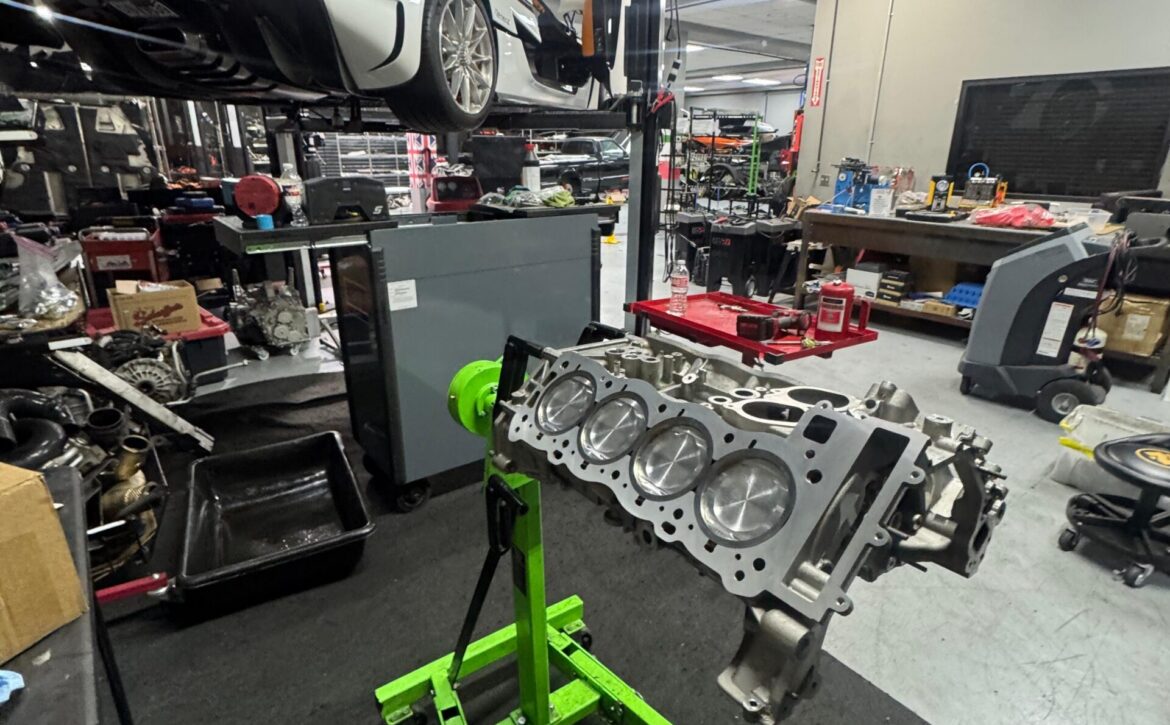
When a McLaren owner in Dallas brings their car in for what they think is a simple oil leak or a misfire, what gets uncovered during a proper diagnostic often tells a different story. A real McLaren engine rebuild in Dallas is not a parts swap. It is a structured teardown, a methodical inspection, and a rebuild sequence that follows engineering tolerances down to fractions of a millimeter. At Motek EuroWerkz, we have completed full M838T and M840T engine builds, and the gap between a proper rebuild and a surface repair job becomes obvious fast. This is what that gap actually looks like.

The Three Failure Modes That Bring a McLaren Engine to the Build Bench

Most McLaren engine problems fall into one of three categories, and each one requires a different level of intervention. Understanding which failure mode you are dealing with determines everything about how the engine gets handled next.

Cylinder Bore Coating Wear

McLaren uses a Nikasil-style cylinder bore coating on both the M838T and M840T platforms. This coating is harder than cast iron sleeves and reduces friction at operating temperature, but it is not indestructible. High-mileage engines, engines run consistently hard without proper warm-up, and engines that saw extended periods of oil degradation all show coating wear on inspection.

The problem with bore coating wear is that it rarely triggers a fault code. By the time it shows up as a performance issue, ring seal has already been compromised. The only reliable way to confirm bore condition is through a bore scope inspection and cylinder leakdown test. A shop that skips this step during a rebuild and assumes the bores are fine is setting up the owner for a repeat visit within 18 to 24 months.

IPAS Bearing Failure

The IPAS (Integrated Pre-Assembled System) main bearing is one of the most discussed failure points in McLaren’s twin-turbocharged engines. It is not a flaw in the platform design so much as a sensitivity that demands strict maintenance habits and correct oil specification throughout the engine’s life.

IPAS bearing failure happens in stages. In the early phase, oil film degradation begins at the bearing surface. In the middle phase, metal-to-metal contact starts transferring material onto the crankshaft journal. By the time the engine throws a rod bearing noise, journal surface damage has already occurred. A shop that replaces the bearings without measuring and potentially regrinding the crankshaft journals is not completing the repair. It is delaying the next one.

At Motek, every M838T and M840T rebuild includes crankshaft journal measurement against OEM spec tolerances. We document the readings and make the journal regrind decision based on actual data, not on visual inspection alone. You can learn more about how we approach these platforms on our McLaren service page.

Hot-Side Turbo Housing Fatigue

The McLaren twin-turbo setup runs the hot-side housing under sustained thermal stress that most street cars never experience. Track use, repeated wide-open-throttle runs, and extended periods of high-load highway driving all accelerate hot-side fatigue. The cast iron housings develop micro-cracks over time, and those cracks do not always present as visible exhaust leaks. They present as inconsistent boost, reduced spool response at lower RPM, and in some cases, a faint exhaust odor under boost that owners often attribute to something else entirely.

A proper McLaren turbo inspection includes pressure testing the housings, checking wastegate actuator response, and measuring turbine shaft play against the specification range. A shop that visually inspects the turbo and calls it serviceable has not done the work.

Factory-Spec Teardown Protocol on the M838T and M840T

McLaren publishes technical reference documentation through their TechInfo portal that outlines the correct disassembly and measurement sequence for both the M838T (used in the 570S, 600LT, and 720S) and the M840T (used in the 765LT). Both platforms share a similar twin-turbo architecture but have different displacement, bore spacing, and piston specifications that require platform-specific procedures at every stage.

A proper teardown follows torque sequence documentation during disassembly to prevent warping head surfaces and bearing cap bores. Plastigauge verification is used on every rod and main bearing cap to confirm clearances against spec before any decision is made about whether a bearing can be reused or must be replaced. MDS-platform dimensional measurements cover the crankshaft, camshaft journals, and cylinder bores using calibrated tooling, with every reading logged against the factory allowable range.

This is not optional procedure on a rebuild of this cost and complexity. It is the difference between knowing what the engine actually measured at teardown and guessing at it. Build sheets document every measurement taken and every part decision made, and that documentation travels with the car when it leaves the shop.

Where Shops Cut Corners on McLaren Engine Builds

The most common shortcut is the parts swap without full disassembly. A shop pulls the heads, replaces the visible problem component, and reassembles. This approach ignores bore condition, bearing clearances, and crankshaft surface integrity entirely. The engine goes back together and it runs, until it does not, typically at the worst possible moment.

The second shortcut is skipping MDS measurements and relying on visual inspection. Experienced technicians can spot obvious damage visually, but clearance measurements require calibrated tooling and documented readings. Visual inspection does not catch a crankshaft journal that is 0.003 inches undersize or a cylinder bore that is out of round by two-thousandths. Both of those conditions will cause premature bearing failure in a rebuilt engine.

The third shortcut is sourcing non-OEM or unverified aftermarket bearings for a platform engineered with specific oil clearances. Bearing clearance on the M838T crankshaft runs within a tight tolerance window. A bearing that is slightly undersized will run tight and accelerate wear under heat. One that is slightly oversized will allow too much journal movement and reduce oil film stability at high load. Neither failure is dramatic at first, and both are invisible until a deeper problem surfaces.

None of these shortcuts show up on the invoice. None of them are visible to the owner until the car is back in the shop. By then, the cost of a proper repair has increased, not decreased.

Motek’s Documented Build Process for M838T and M840T Engines

Every McLaren engine rebuild at Motek EuroWerkz starts with a documented inspection phase before any parts are ordered. We complete a full teardown and measure everything that matters. The owner receives a written summary of findings with actual measured values and a parts list that reflects what the engine needs based on those findings, not a generic rebuild package applied without context.

From there, the rebuild follows factory torque sequences with documentation at each stage. We use OEM-spec bearings as the baseline and upgrade only when a client has a documented power target that requires deviation from stock specification. Cylinder bore work, when needed, goes to a machine shop we have a working relationship with, and those measurements are verified on return before reassembly begins.

Hot-side turbo housings are pressure-tested on every engine that comes through for a full rebuild. If a housing fails the test, it gets replaced before the engine goes back together. We do not install a rebuilt engine into a car with a turbo housing that has not been pressure-verified. That is a standard we hold on every build regardless of the client’s timeline pressure.

The final step before delivery is a datalog review under load. For performance-oriented builds, a dedicated dyno session provides the baseline pull and confirms the engine is producing power within the expected range for the specification. This validation step is part of our custom performance build process at Motek and applies to every build where power output is a documented deliverable.

McLaren’s technical reference documentation, available through the McLaren TechInfo portal, outlines the factory measurement and assembly standards that govern this work. We treat those specifications as the baseline for every build and document every engineered departure when a client’s performance target calls for it.

What This Means for McLaren Owners in Dallas

A surface job on a McLaren engine is not a money-saving decision. It is a delayed expense with added labor cost when the overlooked problems surface a year or two later. The M838T and M840T are precision platforms, and they respond to precision work. They also respond to the absence of it, and the feedback is expensive.

If you are evaluating a McLaren engine rebuild in Dallas, a few questions will tell you everything you need to know. Does the shop document measurements at teardown? Do they follow platform-specific torque sequences? Do they pressure-test the turbo housings? Do you receive a build sheet with your car? At Motek EuroWerkz, the answer to all of those is yes.

Our team works on exotic platforms as the core of our business, and McLaren engine builds are a significant part of what we do. If your car is showing symptoms or you have an upcoming service interval where these systems need assessment, contact us through our McLaren service page, review our custom performance build process, or explore our full range of exotic auto repair services to understand the full scope of what Motek delivers in Dallas.


Frequently Asked Questions

How long does a McLaren engine rebuild take at Motek EuroWerkz?

A complete M838T or M840T engine rebuild at Motek EuroWerkz typically takes 3 to 5 weeks depending on parts availability, the scope of internal work identified at teardown, and whether turbo housing replacement is required. Rush timelines can be discussed on a case-by-case basis at intake.

What causes IPAS bearing failure in a McLaren engine?

IPAS bearing failure in McLaren engines is most often caused by oil starvation from extended oil change intervals, heat cycling without a proper warm-up protocol, and the use of non-OEM oil viscosity specifications. Once the bearing loses its oil film, material transfer to the crankshaft journal can occur quickly and without any audible warning until the damage is already significant.

Can a McLaren M838T engine be rebuilt to a higher performance spec than stock?

Yes. The M838T architecture supports performance builds that exceed factory output through forged piston upgrades, ported cylinder heads, and matched turbocharger upgrades. Motek documents every departure from OEM specification in the build sheet and validates all performance builds with a dyno session before the car is delivered.

Read More
0
Car RepairTips & News
May 24, 2026by Motek EuroWerkz

Car Wraps vs. Paint: Which Is Right for Your Exotic or Luxury Vehicle in Dallas

Two owners walk into our Plano shop with the same car and the same problem. Both have a four-year-old Lamborghini HuracÃĄn. Both want a fresh look. One has a clear-coat that’s starting to spider-crack from years of Texas sun and tar-pit dealer parking lots. The other has flawless paint but is bored with the factory Arancio Borealis and wants something different.

Same shop, same car, same starting point. Two completely different right answers.

One walks out with a full repaint. The other walks out with a satin-finish wrap. And the gap between those two decisions is where most owners get the worst advice on the internet. So let’s settle it. When do you wrap, when do you paint, and what nobody on Reddit will tell you about either.

The Core Difference in 30 Seconds

A wrap is a vinyl film applied over your existing paint. It’s removable, it changes color or finish without permanent commitment, and it protects the original paint underneath. A repaint strips the existing finish and rebuilds the color and clear-coat from the substrate up. It’s permanent, it costs more, and it’s the only path to truly fixing damaged or oxidized paint.

Both are legitimate. Both have a place. The wrong call costs you tens of thousands of dollars at resale.

When a Wrap Is the Right Call

You want a different color, but the factory paint is good

This is the wrap’s strongest case. Your factory paint is healthy, your clear-coat is intact, you just want the car to look different. A high-quality vinyl from a tier-one supplier (3M 2080, Avery Dennison Supreme, KPMF K88500) will change your car’s appearance without permanently committing you. In three or five years when you’re bored again. Or when you go to sell. The wrap comes off and your original Rosso Corsa is still there, factory perfect.

For exotic owners thinking about resale, this is the unbeatable argument. A factory color always sells faster and stronger than a custom repaint. A wrap lets you have both: the custom look you want today, and the original paint when it’s time to move the car.

You want paint protection (PPF, satin, color-shift)

Paint Protection Film (PPF) is a clear vinyl that sits on top of factory paint and absorbs rock chips, road tar, light scratches, and salt damage. On exotics that see real road miles, PPF on the front clip is no longer optional. It’s the difference between selling the car with a $4,000 stone-chip repaint or selling it with a $400 film replacement.

Satin and color-shift wraps deliver finishes that paint physically cannot replicate. A factory-spec satin finish in the wrap world is a different beast from a “satin clear” repaint. Wrap satin has a depth and consistency a painted satin never quite matches.

You want to keep the car drivable during the work

A full wrap is typically a one-week shop stay. A quality repaint on an exotic is three to six weeks minimum, sometimes longer if panel disassembly or color matching is involved. If you have a track weekend on the calendar or a client meeting that requires the car, the wrap timeline wins.

When a Repaint Is the Right Call

The factory paint is damaged, cracked, or oxidized

This is the moment when a wrap stops being an option. You cannot wrap over failing paint and expect it to last. The vinyl will adhere to a substrate that’s already separating, and within months you’ll see lifting at panel edges, bubbling over compromised clear, and adhesion failure in heat-cycled areas like the hood and roof. We’ve removed wraps applied over bad paint that took the underlying paint off with them in sheets.

If your clear-coat is spider-cracked, peeling, or hazing, a repaint is the only honest path. Same for cars that have lived outdoors in Dallas for years. The UV damage isn’t cosmetic, it’s structural to the finish, and a wrap is a band-aid that costs you the substrate.

You want a true factory three-stage or candy finish

Factory exotic colors like Lamborghini’s Verde Mantis, Ferrari’s Giallo Modena Tristrato, or McLaren’s MSO Solar Yellow are multi-layer paint systems. Pigment coat, mica or pearl coat, clear coat. Each layer reads light differently. No wrap on the market can replicate the depth and parallax of a real three-stage paint job.

If you want that effect, you paint. Period.

You’re restoring, not refreshing

If the car is going through a full restoration. Stripped to bare panels, fender repairs, glass out. You’re already at the repaint stage by default. Spending $6,000 on a wrap to cover up restoration-quality body work is the kind of decision that haunts owners at resale time. Do the work right, paint it, document the job.

You’re selling for top dollar in 6 to 18 months

Sounds counterintuitive but the math is clear. A documented professional repaint by a known shop with photo records and proof of process can add resale value. A wrap, no matter how good, is removed before sale by 80% of serious buyers. And what’s underneath had better be in showroom condition. If the underlying paint has issues, the buyer will find them in the PPI and the deal gets re-negotiated.

What Nobody Tells You About Either Choice

The prep work is the entire job

For both processes. A bad wrap install over poorly-prepped paint looks like a bad wrap install in six months. And the install shop will tell you the vinyl is fine, which it is, while pointing fingers at the substrate. A bad paint job over poorly-prepped panels reveals itself the first time the car sees direct sun: orange peel, fish eyes, micro-blistering, color inconsistency across body panels.

When you interview shops for either job, ask about the prep stage specifically. How many hours? What chemicals? What grit progression? If you get a vague answer, walk out.

The cost gap is smaller than you think

A full quality wrap on a HuracÃĄn or 720S runs $7,000 to $12,000 depending on film tier, finish, and complexity. A proper exotic repaint at a marque-experienced shop runs $15,000 to $35,000+ depending on panel disassembly, color system, and post-paint detail. The wrap is cheaper, but not by the order of magnitude many owners assume. For a 4x reversibility premium plus PPF-equivalent protection, the wrap math often wins for owners who don’t have a damaged-paint problem to solve.

The shop matters more than the product

A tier-one vinyl applied badly is worse than a tier-three vinyl applied well. A premium paint system sprayed in a contaminated booth produces worse results than a mid-tier system sprayed correctly. The cheapest way to ruin an exotic is to hand it to a shop that doesn’t specialize. Ask for completed-work photos on cars matching yours. Ask about cure protocols. Ask about color matching on factory finishes.

How Motek EuroWerkz Approaches Both

At Motek EuroWerkz we run dedicated installation and paint booths because the two processes don’t share equipment well. Our wrap shop uses tier-one films exclusively, with documented surface prep protocols and post-install cure documentation. Our body and paint operation handles factory color matching on three-stage systems with spectrophotometer verification and panel-by-panel test sprays before any final coats.

Whichever direction is right for your car, we’ll tell you honestly. Even if it means recommending you don’t spend money with us. A wrap on bad paint is a problem we don’t want our name on, and a repaint on a car that just needed a color change is money the client didn’t have to spend.

Ready to Decide?

If you’re in the Dallas, Plano, Frisco, Highland Park, or Southlake area and you’re weighing wrap vs. paint on a Ferrari, Lamborghini, McLaren, Porsche, Aston Martin, or any other exotic or luxury vehicle, schedule a consultation with Motek EuroWerkz. We’ll inspect the existing finish, walk you through both paths with real cost numbers, and recommend the route that actually serves the car and your timeline.

Read More
0
Car RepairTips & News
May 24, 2026by Motek EuroWerkz

Custom Builds in Dallas: How Motek EuroWerkz Approaches a Full Performance Build

Here’s the truth nobody in the build scene wants to say out loud: a custom performance build done wrong costs you twice. Once when you pay for it the first time, and again when you pay someone competent to undo the damage. We’ve seen cars roll into our Plano shop with mismatched tunes, undersized fueling, suspension geometry that fights itself, and turbo setups that were doomed the moment the parts list was finalized. The owners always say the same thing: “I just wanted to make it faster.”

Real custom performance builds in Dallas aren’t about throwing parts at a car. They’re about engineering a result. At Motek EuroWerkz, we treat every build the way a fabricator treats a one-off chassis. With a plan, a baseline, and a hard line between what looks cool on Instagram and what actually works at 4,500 RPM on a 105-degree Texas afternoon.

What a Real Custom Build Process Looks Like

Before a single bolt comes off your car, the build lives on paper. Here’s how we run it.

1. The Consultation

We sit down with the owner and have an honest conversation. What’s the car for? Daily driver with weekend track days? Pure street car that needs to embarrass exotics at a stoplight? COTA or ECR habit? Is this a forever car or a stepping stone? The answers shape every decision downstream. A 700-hp build for a guy who drives to dinner is a different car than 700 hp for a guy who pulls 40-minute sessions at Eagles Canyon.

2. Dyno Baseline

Before we touch anything, the car goes on the dyno. We need to know exactly where it is today. Power, torque curve, AFRs, knock behavior, boost response if it’s already forced induction. This baseline is the proof. When the build is done, the delta isn’t a guess. It’s a number.

3. Parts Selection

This is where most shops cut corners. We don’t spec parts because we have them on the shelf. We spec them because they match the build’s power target, drivetrain limits, and intended use. Forged internals from a known foundry. Turbos sized for the actual airflow target, not the brochure horsepower. Fueling that supports the goal with margin, not “just enough.” Cooling that survives a Texas summer in stop-and-go on the Tollway.

4. Build Stages

Every major build runs in stages with checkpoints. Engine out. Bottom end assembly. Head work. Long block back in. Fueling and forced induction. Cooling and ancillaries. Tune. Each stage gets photographed, documented, and signed off before the next begins. If something doesn’t look right at stage three, we don’t bury it under stage four.

5. Validation

Final dyno. Heat cycles. Leak-down. Datalog review across multiple pulls and load conditions. Street and track shakedown. We don’t hand a customer the keys until the car has proven itself through a full validation cycle. And we share the data with the owner. You should know what your car actually makes, not what we tell you it makes.

Types of Builds We Do

Motek isn’t a one-trick shop. The build sheet ranges across:

  • Engine builds. Forged bottom ends, head porting, cam packages, displacement increases on European platforms (Porsche, BMW, Audi, Mercedes-AMG, Lamborghini, McLaren).
  • Suspension builds. Coilover programs, corner balancing, alignment to spec for street, track, or hybrid use. Bushings, sway bars, geometry corrections on lowered cars.
  • Forced induction. Turbo upgrades, supercharger conversions, complete twin-turbo systems on naturally aspirated platforms.
  • Full restorations. Air-cooled Porsches, classic M cars, European GT cars that deserve to come back better than factory.

Why Dallas Is Becoming a Build City

The Dallas market for serious custom builds has exploded over the last three years, and it’s not an accident. The metro is full of people who can afford the car they actually want. And increasingly, they want something nobody else has. Plano, Frisco, Southlake, Highland Park, University Park. The density of exotic and high-end European metal here rivals anywhere in the country outside of Miami or LA.

What’s missing in most markets is the shop that can actually execute. Dealers won’t touch custom work. National chains don’t have the depth. That’s the gap we built Motek to fill. A Dallas-area facility with the tooling, the tuning expertise, and the discipline to handle a build from concept to keys-in-hand.

Ready to Build Something Real?

If you’ve got a car worth building and you’re tired of shops that quote off a parts list and hope for the best, come talk to us. Bring the car. Bring the goals. We’ll tell you honestly what’s possible, what it costs, and how long it takes. Schedule a build consultation with Motek EuroWerkz and let’s draw up a real plan.

Read More
0
Car RepairTips & News
May 14, 2026by Motek EuroWerkz

How to Find a Trustworthy Exotic Car Shop in Dallas (What to Look For)

Your exotic deserves better than guesswork. Whether you’re driving a Ferrari 488, a Lamborghini HuracÃĄn, a McLaren 720S, or a Porsche 911 Turbo S, the wrong wrench in the wrong hands can turn a $4,000

Read More
0
Car RepairTips & News
May 7, 2026by Motek EuroWerkz

Porsche GT3 Cup vs Street 911: The Real Differences | Motek EuroWerkz

Porsche GT3 Cup vs street 911: chassis, drivetrain, electronics, and what track-only race cars demand vs. street-spec maintenance.

Read More
0
Car RepairTips & News
April 30, 2026by Motek EuroWerkz

Performance Tuning and Dyno Testing Dallas TX | Motek EuroWerkz

Performance tuning and dyno testing in Dallas, TX. Mustang dyno, before-and-after sheets, and what an honest tune actually looks like.

Read More
0
  • 1
  • 2
Featured author image: Inside a McLaren Engine Build: What Separates a Real Performance Rebuild From a Surface Job

Derek Speed

Follow Me. Be in Trend.

Categories
  • Car Repair12
  • Tips & News12
Related Posts
No posts were found for display
Gallery
Image 1
Image 6
Image 5

Image 4
Image 3
Image 2

Featured image: Inside a McLaren Engine Build: What Separates a Real Performance Rebuild From a Surface Job

Need Help? We are Here to Help You!

free quote

SERVICES

  • McLaren Service And Repair
  • European Auto Repair
  • Exotic Auto Repair
  • Mon-Fri: 08:00 AM - 06:00 PM
    Sat-Sun: CLOSED

ABOUT US

  • About us
  • Contact us
  • Blog
  • 469-298-2880
  • service@motekeuro.com

Terms of Service | Privacy Policy

Powered by Quantm Media

  • 1601 N Central Expy, Plano, TX 75075
Instagram Facebook-f Yelp Youtube