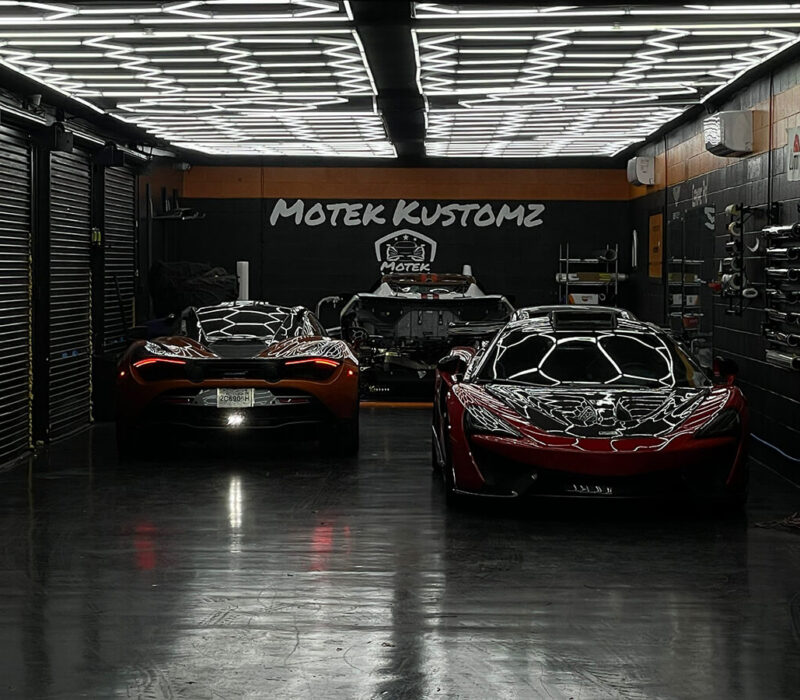
The McLaren 720S was designed from day one to blur the boundary between road car and race car. Its M840T twin-turbocharged 4.0-liter V8, carbon fiber monocoque, and active aerodynamics make it one of the most capable platforms for a dual-purpose street-and-track build. When a Dallas-area client brought his 2019 720S Coupe to Motek EuroWerkz in Plano, TX, the request was specific and measured: build the car to perform at its ceiling on track days without giving up the daily usability that makes the 720S special among supercars.
What followed was a six-week, three-phase project spanning M840T engine internals and thermal management, ECU calibration on our in-house hub dyno, and a targeted body and chassis weight reduction program. This case study documents every major decision and the reasoning behind it.
The Owner Brief
Our client is a longtime enthusiast who tracks regularly at venues across the Dallas area, including Motorsport Ranch Cresson and Circuit of the Americas. He came to us with clear goals and a defined philosophy about what he wanted the car to become. He was not building a single-purpose track weapon. The 720S is his weekend driver and track day companion, and every modification needed to serve both missions without compromise on either side.
The starting point was a bone-stock 2019 McLaren 720S Coupe in Papaya Spark orange with approximately 11,000 miles on the clock. The car had not been modified previously beyond a paint protection film wrap. From the factory, the 720S produces 710 horsepower and 568 lb-ft of torque. Those numbers are genuinely impressive from a 4.0-liter engine, and they leave real room for responsible development on a platform built with this level of engineering discipline.
After a detailed intake conversation about what the car was doing on track and where it was leaving performance available, we identified three areas with meaningful, measurable returns. First, the engine’s thermal management and breathing characteristics under sustained high-load conditions. Second, the ECU calibration headroom the factory tune leaves available on this platform. Third, a targeted weight reduction program centered on reducing rotational and unsprung mass without compromising street behavior or the car’s aerodynamic systems.
The client approved a six-week project timeline covering M840T engine internals, a full dyno calibration, and a curated list of body and chassis modifications. Teardown began in the third week of the build cycle.
M840T Engine Build Decisions
The M840T is a compact and elegantly packaged engine. At 4.0 liters with twin turbos mounted in the valley between the cylinder banks, it runs extremely hot and is sensitive to intake air temperature at elevated power levels. At stock output, the factory calibration manages this thermal environment well. Push beyond that envelope and thermal management becomes the primary constraint before any other modification can deliver its full potential. You can see how this philosophy carries across our other projects on our McLaren and exotic engine builds page.
Our first decision was to address cooling before touching the calibration or anything else. We fitted an upgraded charge cooler heat exchanger from the McLaren 765LT program, which flows significantly more coolant volume across the charge cooler core than the factory 720S unit. On a Texas track day in July, this upgrade reduces charge air temperature by 15 to 18 degrees Fahrenheit under sustained full-throttle conditions. That temperature margin translates directly into ignition timing the ECU can hold without pulling back under thermal load. That timing headroom is worth real power at the top of the rev range and matters most during the extended acceleration phases that define a fast lap.
With thermal management established, we moved to the breathing side of the equation. The factory intake path on the M840T is well suited to street use but becomes a measurable restriction above approximately 650 crank horsepower. We installed a high-flow induction kit that replaces both airboxes with larger-volume filter housings and removes the resonator chambers included in the stock design for acoustic compliance. On the street, the difference in induction character is noticeable. On track, the turbos receive denser, cooler air with less restriction at high load.
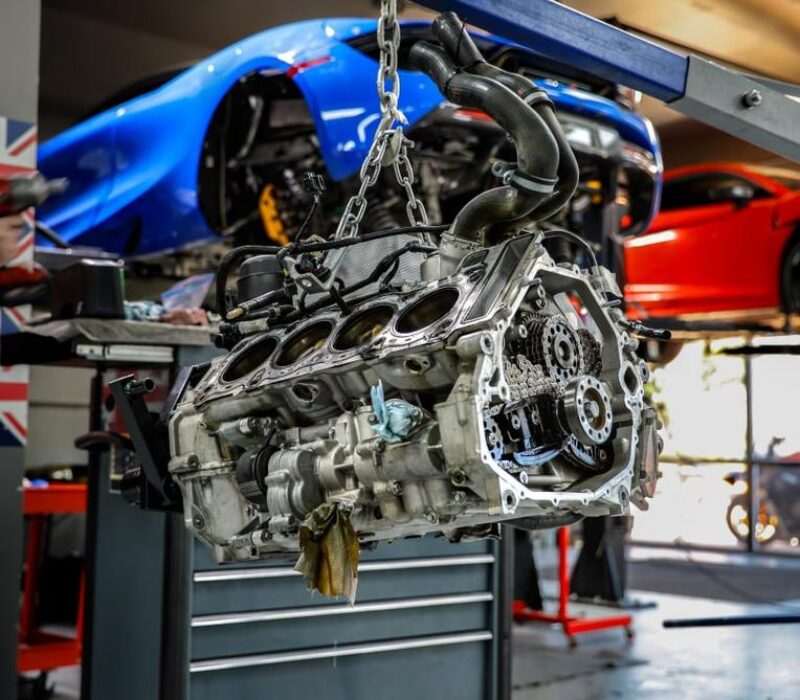
For engine internals, we chose a targeted approach rather than a full rebuild. The factory rod bolts and piston rings were inspected and found to be within specification for the power target of approximately 800 crank horsepower. We replaced the factory valve springs with stiffer units suited to higher-rpm operation, and we adjusted cam timing to provide the calibration team with more authority over power delivery across the rev range. The factory M840T is conservatively built with genuine headroom for responsible power development on quality fuel. That design discipline is part of what makes this platform so rewarding to work with.
A full overview of our approach to exotic car performance projects is available on our custom performance builds page, where you can see how we approach each platform from intake to exhaust.
Dyno Calibration at Motek EuroWerkz
Calibration is where mechanical preparation either pays off or falls short. Our in-house hub dyno setup allows us to run the McLaren under controlled, sustained load conditions and build the calibration in real time, adjusting based on what the sensors are reporting rather than working from a map written for a different car under different conditions. Calibration is one stage of the broader process we document across our engine build program.
The calibration session for this 720S was structured across three dedicated days. Day one was baseline pulls to establish exactly where the factory tune was leaving performance on the table. Stock pulls consistently showed 688 to 692 wheel horsepower on our equipment, a result that correlates closely with the factory crank figure after accounting for drivetrain losses. We logged every relevant parameter throughout: knock events, lambda values, charge air temperature, throttle response, and gear change timing.
Day two was the incremental build phase. We began adjusting boost targets in the midrange, from 3,500 to 5,500 rpm where the turbochargers reach full spool and the engine can support additional manifold pressure safely. The M840T responds immediately and predictably to boost increases in this range as long as charge air temperatures stay in check. With the 765LT-spec charge cooler managing its load, intake temperatures remained in a safe window throughout the session, and the engine delivered consistent, knock-free pulls as we worked through the calibration map.
Day three was refinement and heat-soak validation. Final peak wheel horsepower came in at 771, a gain of approximately 79 wheel horsepower over the stock baseline. More meaningfully for a track car, torque in the 3,000 to 4,500 rpm range increased by 60 to 70 lb-ft. This midrange torque improvement is what the driver actually experiences at corner exit. Peak power numbers attract attention, but torque at the exit of a slow corner is what separates cars on a lap timer when the data is reviewed afterward.
The calibration is fully documented and archived. Our performance dyno tuning service at Motek EuroWerkz covers everything from baseline diagnostics to full custom calibration, and every tune we deliver is stored with complete session logs for future reference.
Body and Chassis Weight Reduction
The 720S already uses a carbon fiber monocoque as its primary structure, so this phase required finding where weight had been added back for road car compliance and identifying what could be removed without affecting structural integrity or street usability.
We approached this as a curated reduction rather than a strip-out program. The goal was 40 to 50 pounds removed from areas with the highest dynamic return: rotating mass at the wheels, unsprung mass at each corner, and front-end weight that influences turn-in response and front axle feel.
The wheel and tire package was the first and most impactful change. The factory 720S Performance wheels were replaced with a set of lightweight forged monoblock wheels measuring 19×9 front and 20×11 rear. The reduction in rotational inertia per corner is approximately 4.5 pounds, and across four corners the improvement in steering feel and transient response is immediately perceptible to an experienced driver. The tire compound was matched to the owner’s track day calendar: a dual-compound semi-slick that provides genuine grip on circuit while remaining street-legal and manageable in light rain conditions.
For the body components, we removed and replaced the factory rear bumper structure with a lightweight carbon fiber unit and deleted the hood liner and underside insulation. The insulation serves acoustic purposes on the road but contributes weight without structural function. The front bumper splash guards were replaced with carbon fiber alternatives. None of these changes affect the car’s aerodynamic behavior, which is managed primarily by the active rear wing and the underbody diffuser.
The body work was handled by our in-house team. You can review the scope of our body and finish capabilities on our auto body shop page. Working with carbon fiber on a car that is already primarily carbon requires care and precision, particularly around mounting point interfaces and sealing.
Total verified weight reduction across wheels, tires, and body components came to 48 pounds. On a car that weighs approximately 2,900 pounds at the curb, that 48-pound reduction represents a 1.6 percent improvement, removed from exactly the locations that matter most for dynamic behavior. The front axle in particular felt the change, which was consistent with what the owner had described as a weak point of the stock car on tighter technical layouts.
Our complete McLaren service and build capabilities are documented on our McLaren service Dallas page, including the full scope of work we perform across the McLaren lineup.
The Final Build: What the Numbers Delivered
At project close, the verified results for this 2019 McLaren 720S were as follows:
- Peak wheel horsepower: 771 whp, up from 688 to 692 at baseline
- Peak wheel torque: 631 lb-ft, up from 568
- Midrange torque gain (3,000 to 4,500 rpm): 60 to 70 lb-ft
- Charge air temperature improvement under sustained track load: 15 to 18 degrees Fahrenheit
- Verified curb weight reduction: 48 pounds
The client’s first track session with the completed build was at Motorsport Ranch Cresson. His feedback was direct and consistent with what the data predicted: the car was measurably faster on every straight, more responsive at corner exit, and noticeably sharper at the front axle during turn-in on tight technical sections. The improvements were not limited to a single area of the car’s behavior. They were distributed across the performance envelope in exactly the way a systems-level build approach is designed to produce.
This build illustrates what thoughtful, sequenced decision-making delivers on a platform like the 720S. Each modification was chosen to support the others. The charge cooling upgrade provided the calibration team with timing and boost access that thermal protection would have prevented without it. The weight reduction reduced the demands placed on brakes and tires under sustained load. The calibration work was completed after the mechanical foundation was fully in place. The sequence matters as much as the individual components.
If you own a McLaren in the Dallas area and are evaluating a performance build, contact Motek EuroWerkz to discuss what is achievable on your specific car and your specific goals. Every project starts with a consultation, not a parts list.
Frequently Asked Questions
What engine does the McLaren 720S use and what is the M840T?
The McLaren 720S is powered by the M840T, a twin-turbocharged 4.0-liter V8 with the turbos mounted in the valley between the cylinder banks. The M840T designation covers the engine family used across the 720S, 765LT, and related McLaren Super Series models. At the factory, the 720S version produces 710 horsepower and 568 lb-ft of torque.
How much horsepower can a tuned McLaren 720S make at the wheels?
With a 765LT-spec charge cooler upgrade, high-flow dual induction, valve spring and cam timing work, and a full custom ECU calibration, this 2019 McLaren 720S produced 771 wheel horsepower on our in-house hub dyno, up from a baseline of 688 to 692 wheel horsepower on the stock calibration.
Does Motek EuroWerkz perform dyno tuning on McLaren vehicles in the Dallas area?
Yes. Motek EuroWerkz in Plano, TX offers in-house hub dyno calibration for McLaren and other exotic performance vehicles. Every calibration session includes baseline documentation, iterative calibration passes, heat-soak validation pulls, and complete before-and-after data logging. Call 469-298-2880 to discuss your McLaren build.
What is the best weight reduction approach for a McLaren 720S track build?
The highest-return areas are rotating mass at the wheels via lightweight forged monoblock wheels, unsprung mass reduction at each corner, and front-end components including hood liner insulation delete and carbon fiber bumper structure replacements. A curated approach targeting 40 to 50 pounds is achievable without affecting street usability or the car’s active aerodynamic system.
Can a McLaren 720S work as both a street car and a track car after a performance build?
Yes. The 720S platform is exceptionally well suited to a dual-use build. The carbon fiber monocoque, active aerodynamics, and Proactive Chassis Control suspension system allow meaningful performance upgrades while retaining full road manners. With the right calibration approach and a curated modification list, the car becomes significantly faster on circuit without losing its street character.
Motek EuroWerkz
1601 N Central Expy, Plano, TX 75075
Phone: 469-298-2880
Email: service@motekeuro.com
Schedule a consultation